Mobile and self-sufficient working in the Marco Polo office - LTE | WiFi - router and antenna for Mercedes-Benz Marco Polo, Activity, Horizon - incl. installation
- Stay connected at camp: MiMo roof antenna improves weak-signal LTE reception.
- Wi-Fi by your camping chair: Connect multiple devices around your vehicle.
- Your office travels with you: Access your company network via VPN.
- Work without shore power: Router runs directly from the leisure battery.
Item no. 35994
Work, make calls and synchronise your data without relying on campsite WiFi: this LTE/WiFi system with workshop installation combines a Teltonika MiMo router with a Panorama Shark MiMo roof antenna. It gives your Mercedes-Benz Marco Polo, Activity or Horizon its own network for a laptop, smartphone and other devices.
Use a roof antenna rather than relying on your phone alone
The externally mounted antenna and MiMo technology can improve mobile reception compared with using mobile devices on their own. Multiple antenna paths support data transmission. The router uses 4G/LTE Cat 4 with a theoretical maximum of 150 Mbps; 3G and 2G are also listed. The connection you can actually use depends on local network coverage, your data plan and reception conditions.
Without mobile network coverage, this system cannot provide mobile internet access. The 5G reference in the antenna specifications describes the antenna, not the router: the supplied system is not a 5G router.
One WiFi network for work and time at the campsite
The WiFi network serves devices inside and around the vehicle. In open surroundings, a range of several hundred metres may be possible, depending on the location and connected device. Obstacles and local radio conditions affect the usable distance. This allows you to share the network with fellow travellers or neighbouring vehicles. The technical specifications allow for up to 100 simultaneous WiFi connections, which share the available bandwidth.
Cloud synchronisation and backups can run over the shared network if the devices and services are configured accordingly. WiFi calling and SIP calls also require compatible devices, supported services and a sufficiently good internet connection. Automatic backups still require you to check your backup settings and use your data allowance.
Two SIM slots give you more flexibility when travelling
Two Mini-SIM slots in 2FF format and dual-SIM failover allow the router to switch between two inserted cards. Depending on its configuration, it can switch when the signal is weak, no network is available or a data limit has been reached. A second card can also be used when travelling outside the countries covered by your roaming plan. Mobile internet access requires an activated SIM card with a suitable data plan.
VPN functions, including OpenVPN and IPsec, support connections to suitably configured endpoints. This is useful when accessing a company network from your mobile workspace. The appropriate configuration depends on your network requirements.
Power modes for camping and everyday driving
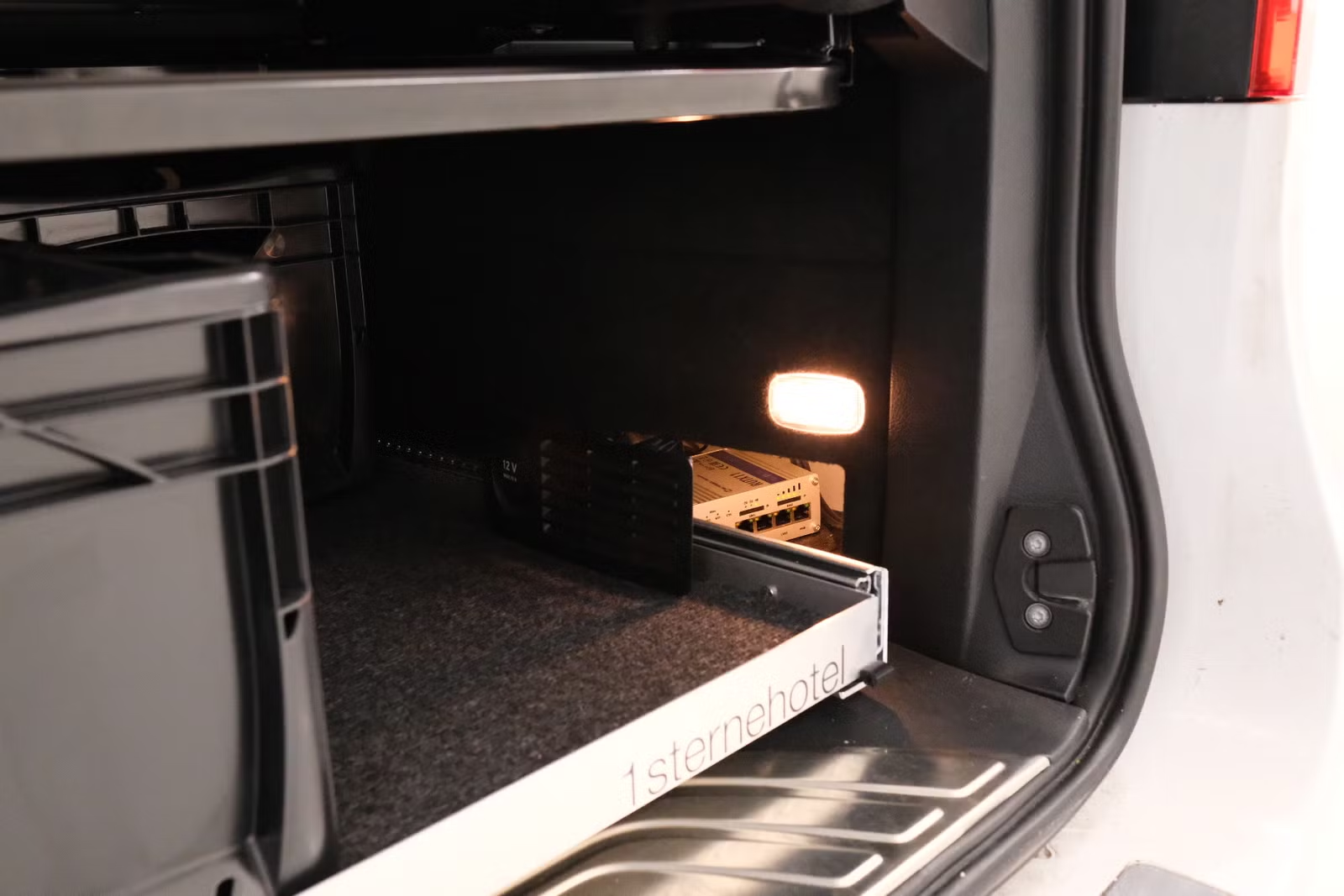
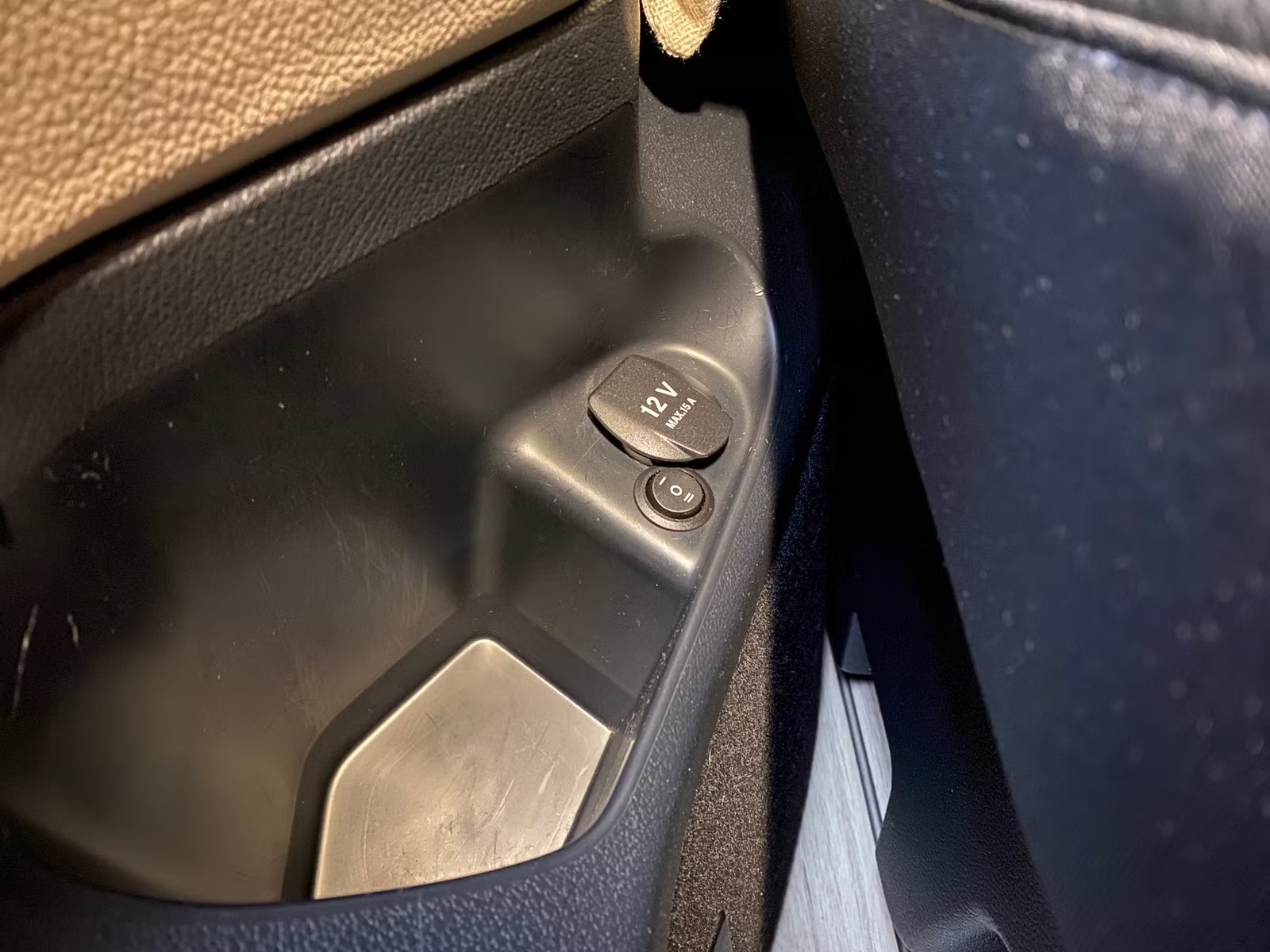
The router is connected to the leisure battery. A switch beside the rear 12 V socket lets you select continuous operation, ignition-controlled operation or complete shutdown. The network can therefore stay on while camping, follow the ignition during everyday use or remain switched off when not needed.
The technical specifications state power consumption below 2 W when idle and below 7 W at maximum consumption. Operating time depends on battery capacity, charge level and other electrical loads. Self-contained operation here means power from the vehicle battery, not unlimited runtime or independence from mobile network coverage.
Hidden installation with access when you need it
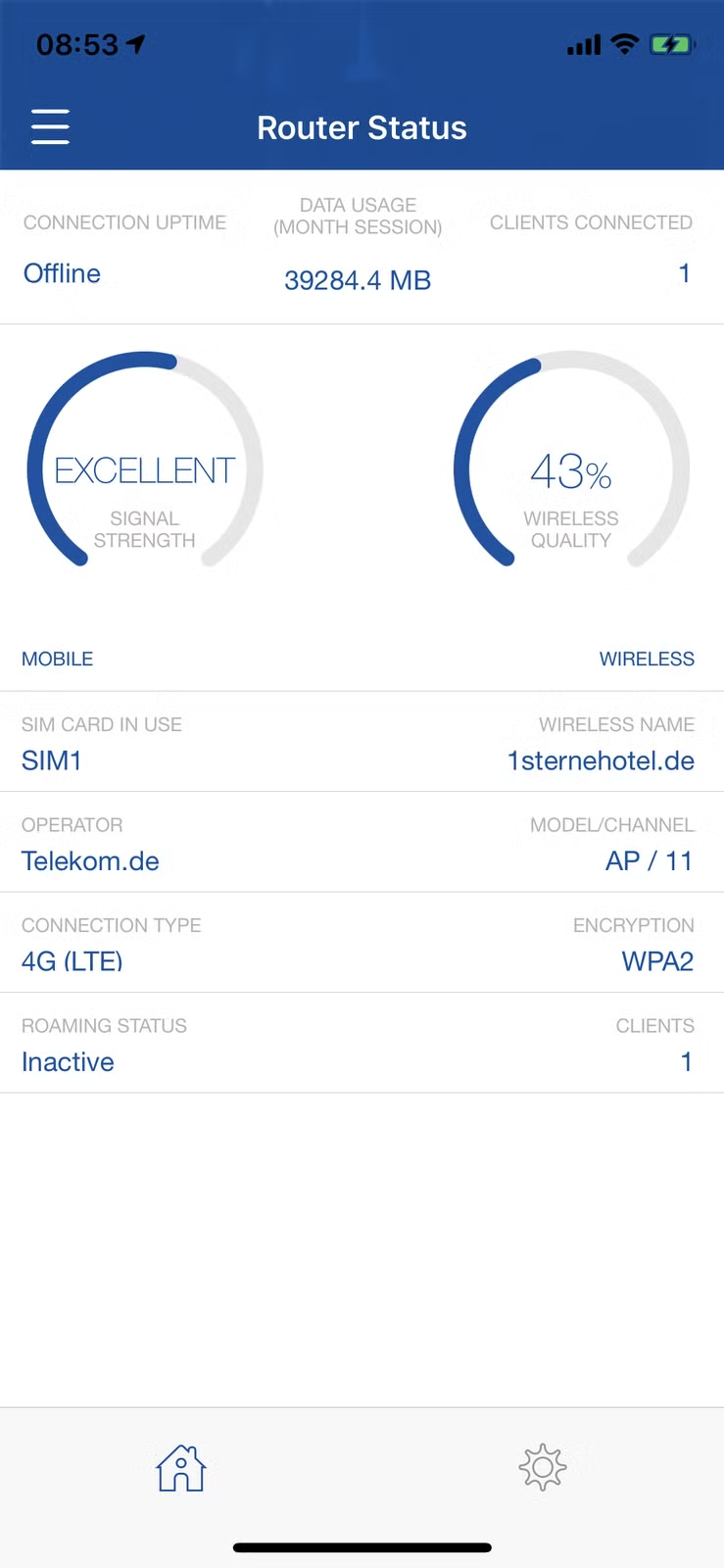
The router is installed behind the trim at the rear right, beside the tailgate, leaving open storage surfaces free. Removing the plastic panel containing the 12 V socket gives access to the SIM slots and router. A smartphone app for Apple and Android allows you to view status information and adjust settings without installing an additional display.
Up to four Ethernet cables can be connected within the vehicle on request. The router provides three LAN ports and one WAN port that can be configured as LAN, each rated at 10/100 Mbps. WiFi can be switched off when using wired connections.
Integrated into the pop-top without increasing vehicle height
The system is described for Mercedes-Benz Marco Polo, Activity and Horizon vehicles with an electric or manual pop-top roof, with or without a sunroof. These product details do not specify compatibility with the Viano Marco Polo W639.
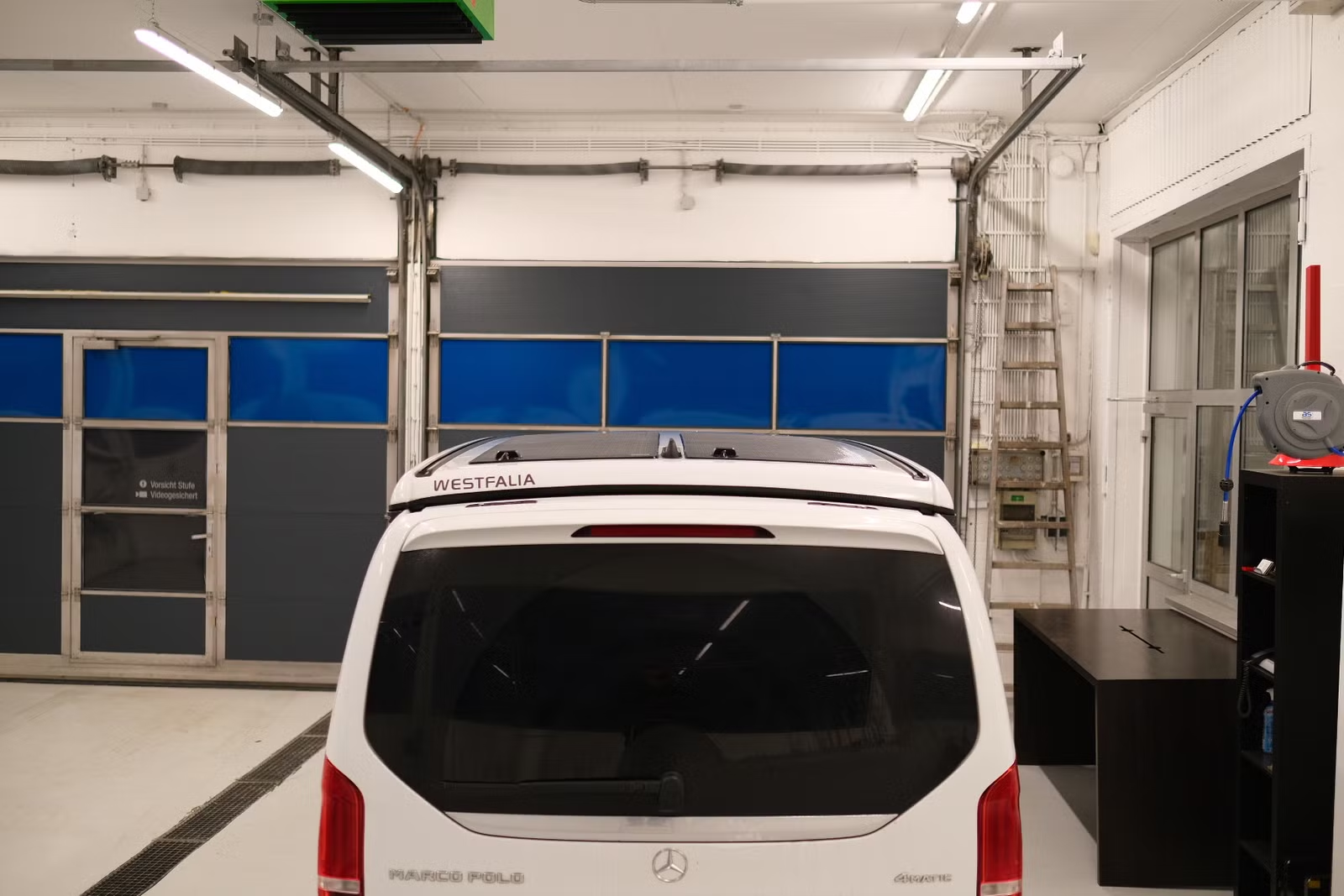
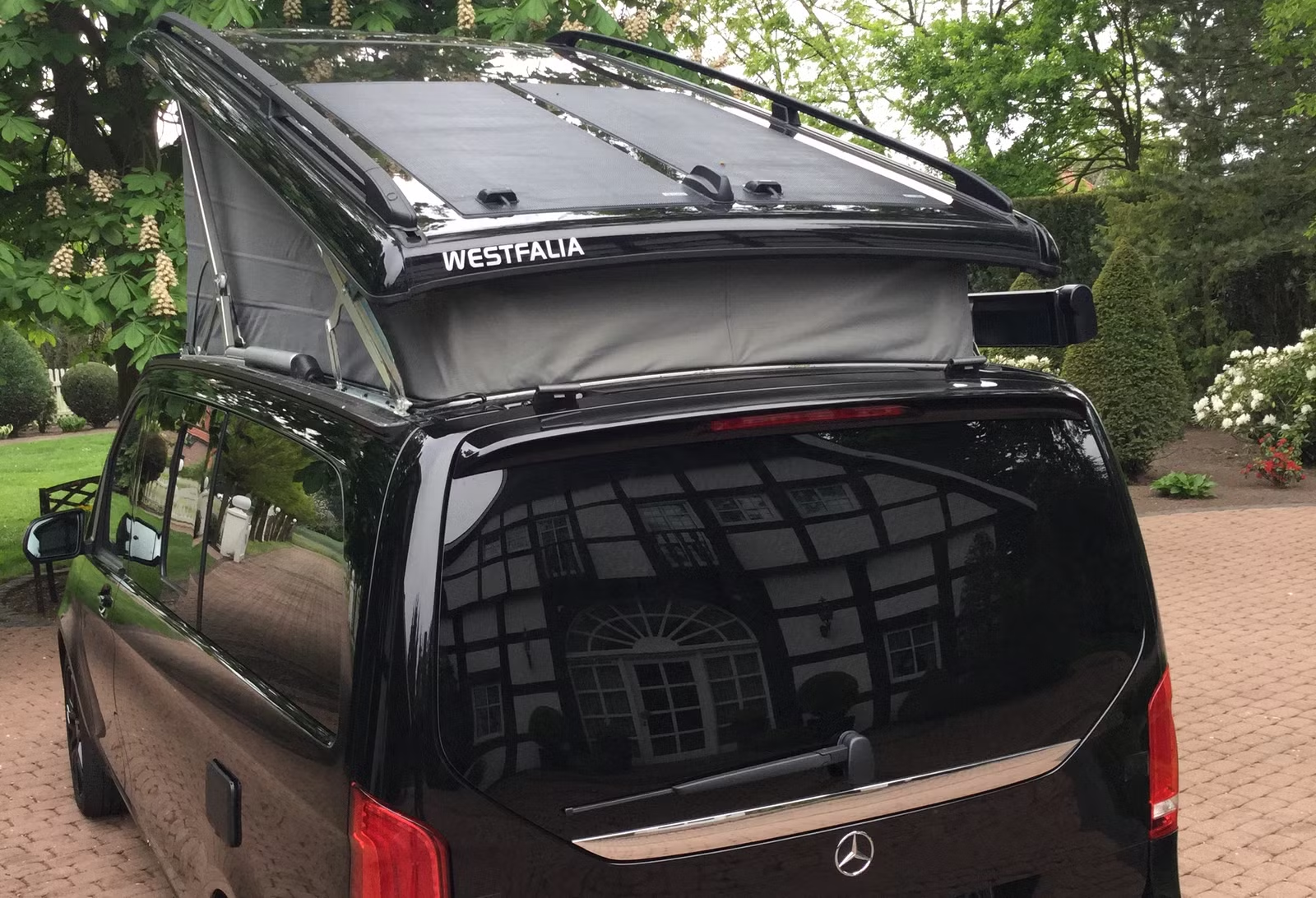
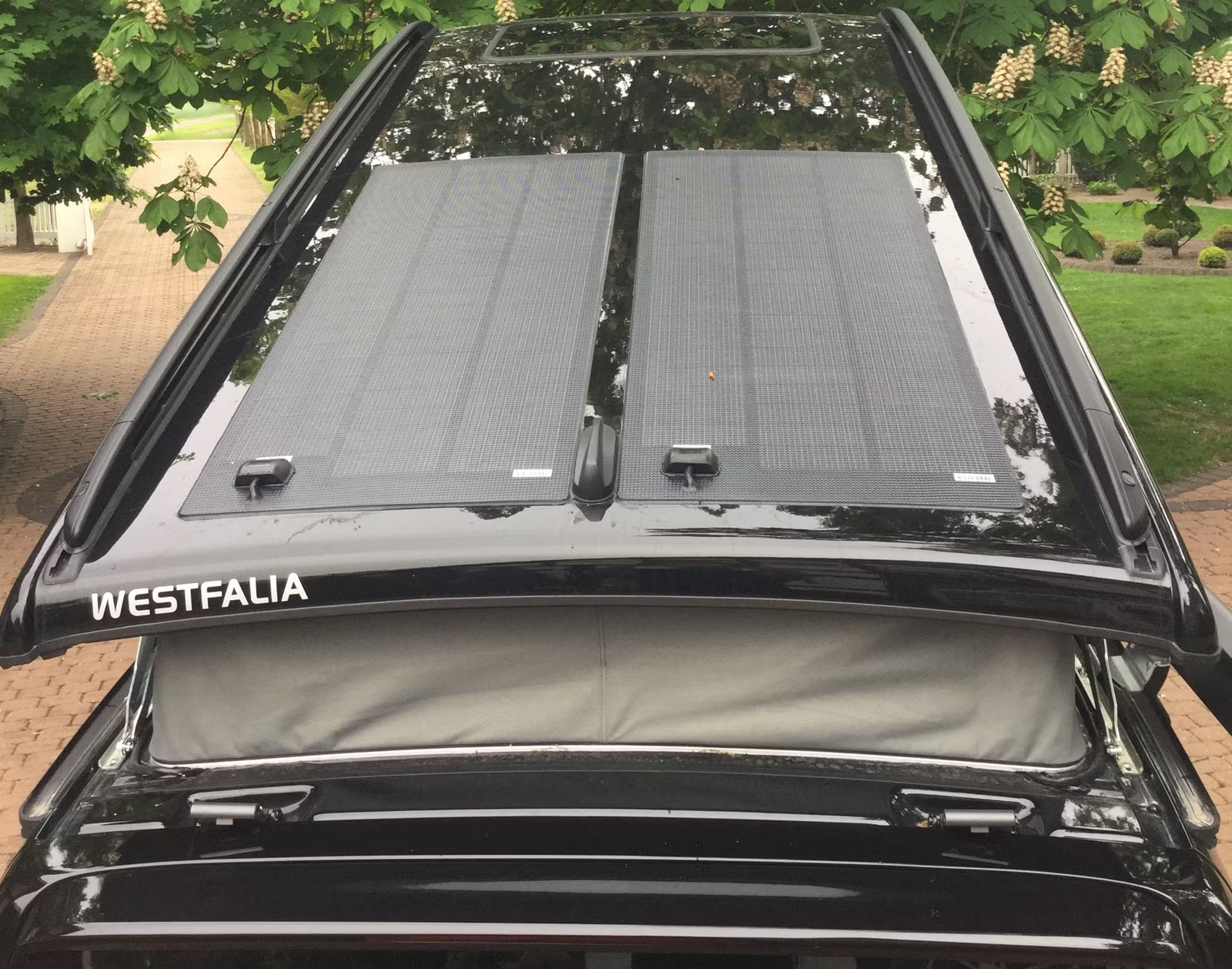
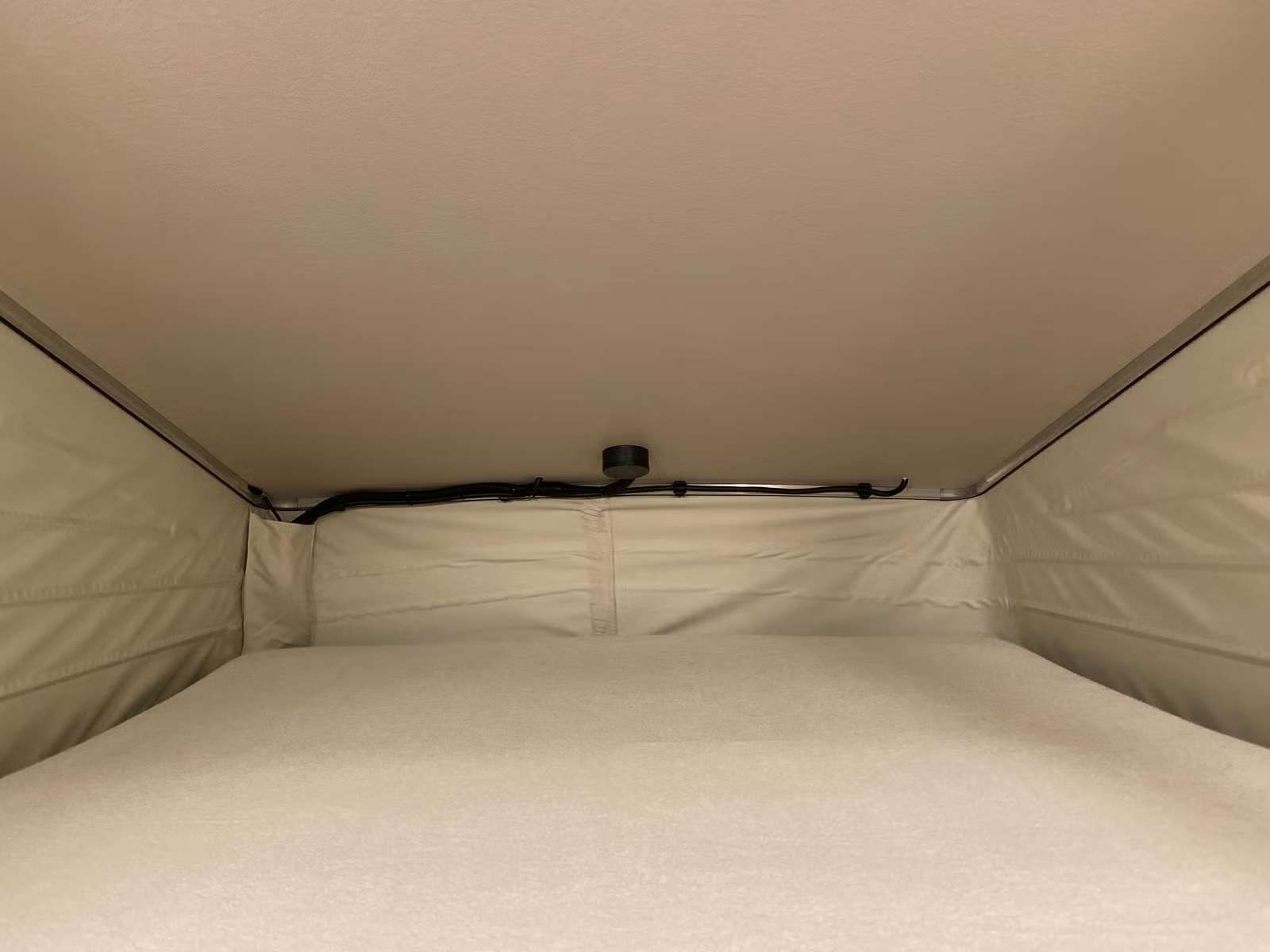
Installation requires a hole in the pop-top roof. The antenna cables are routed flexibly into the interior and remain visible around the roof bed. Their routing accommodates both use of the bed and lowering of the roof.
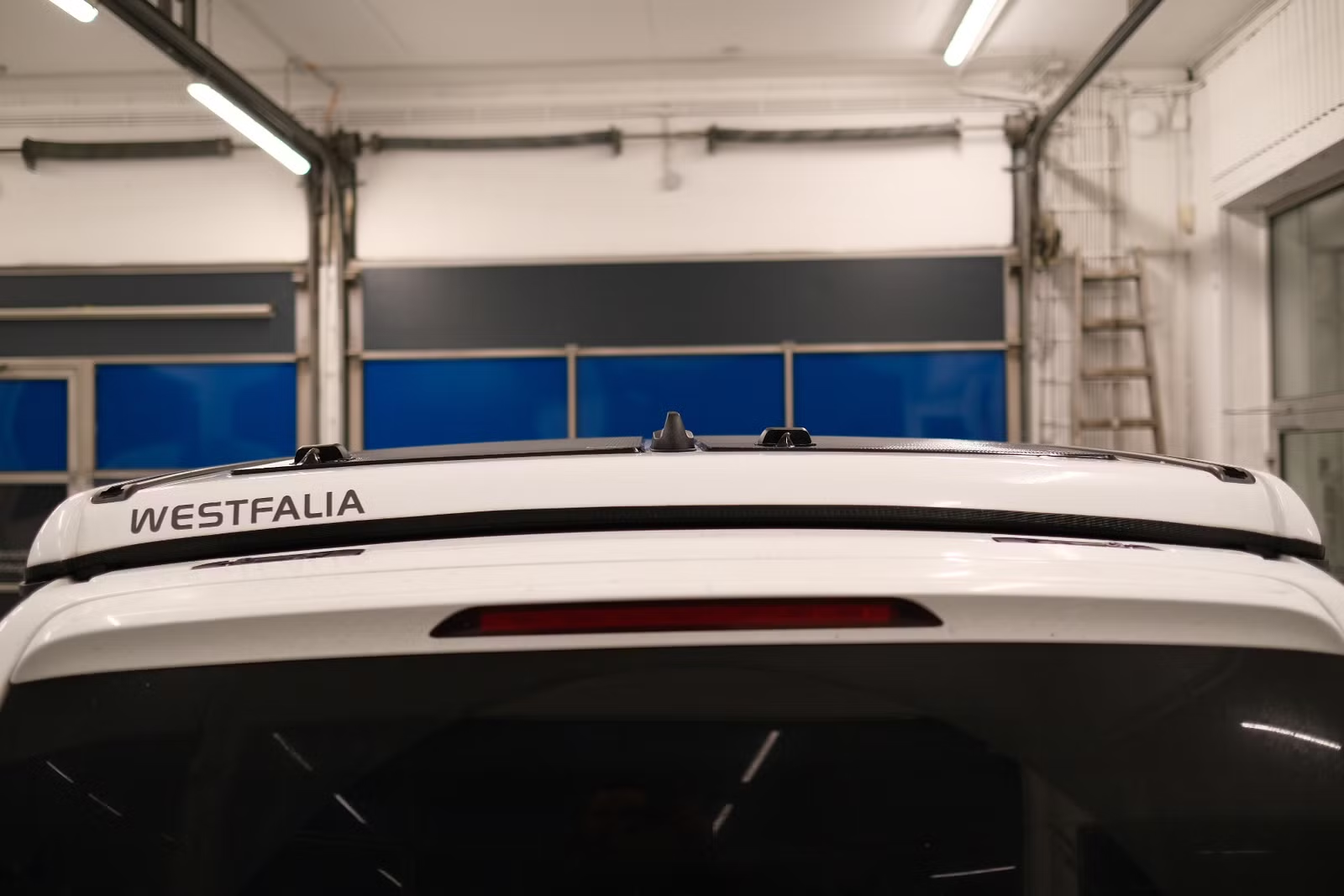
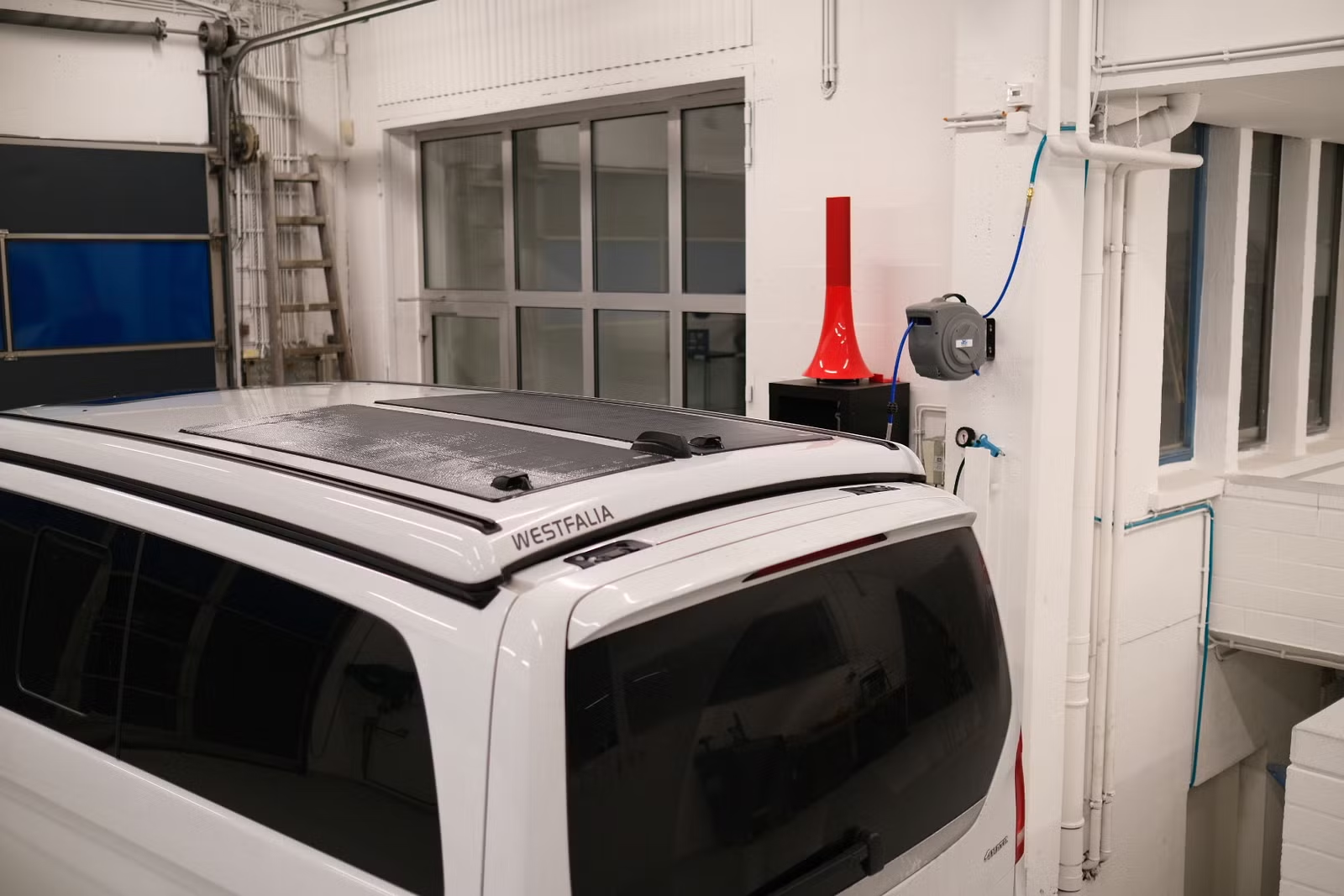
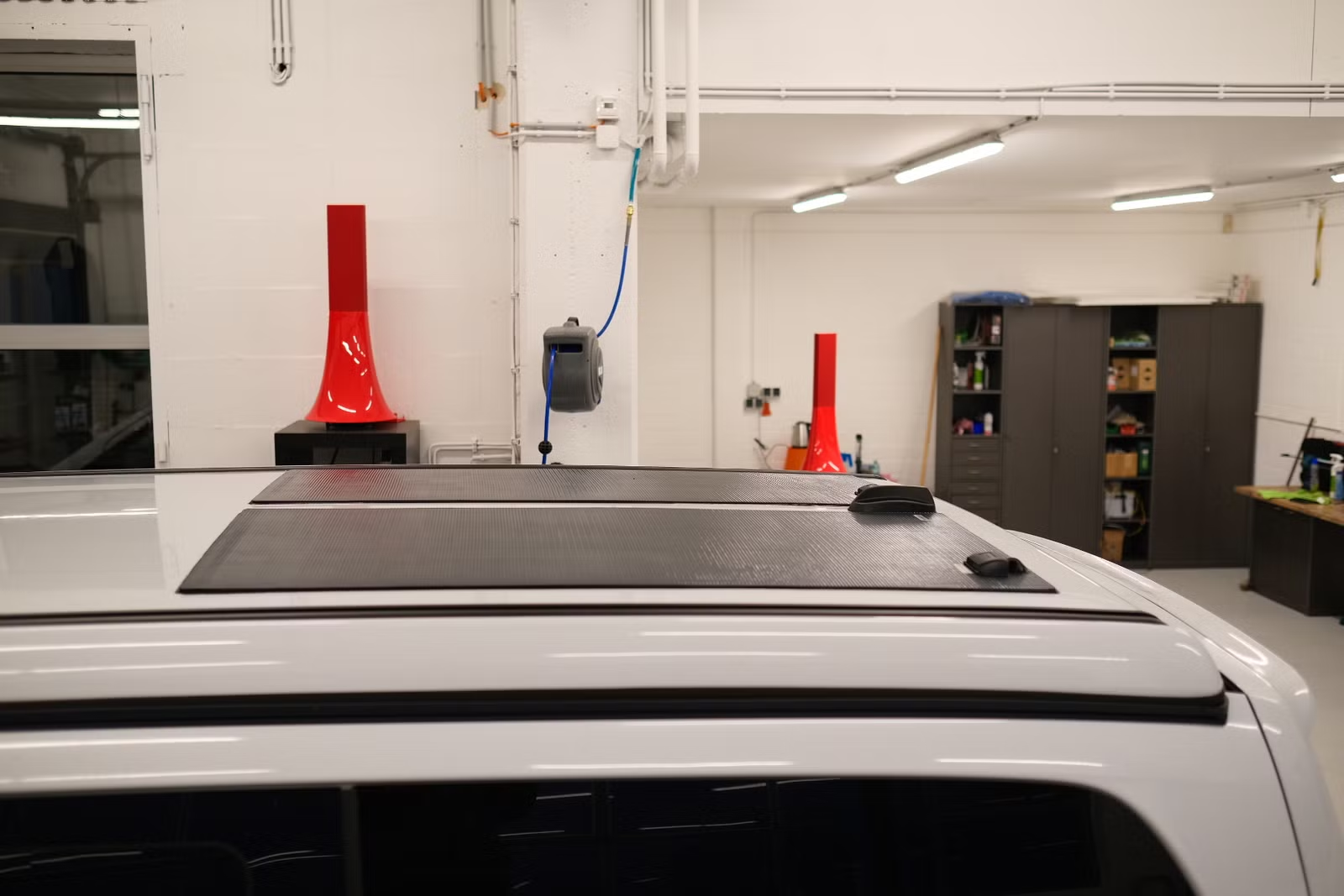
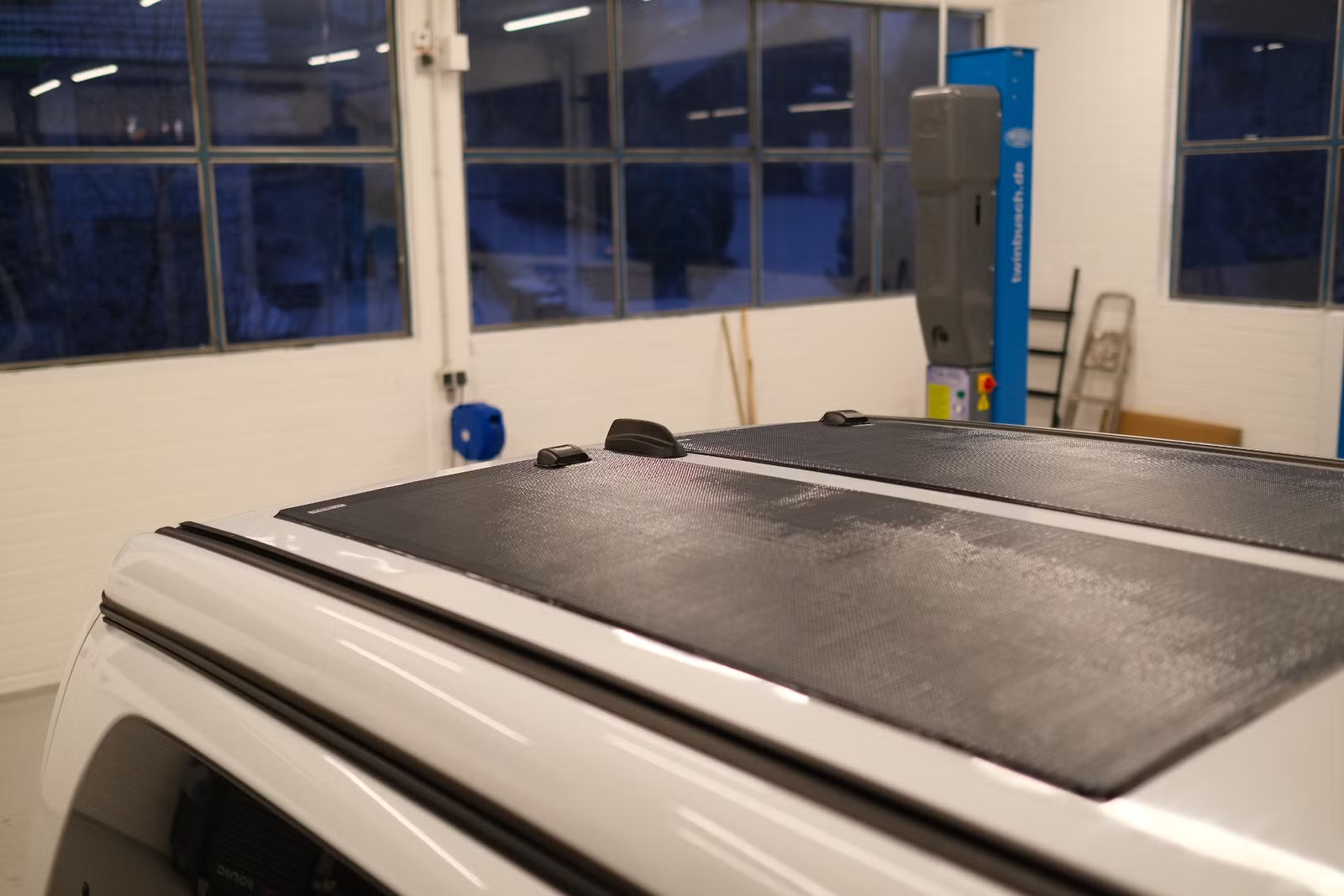
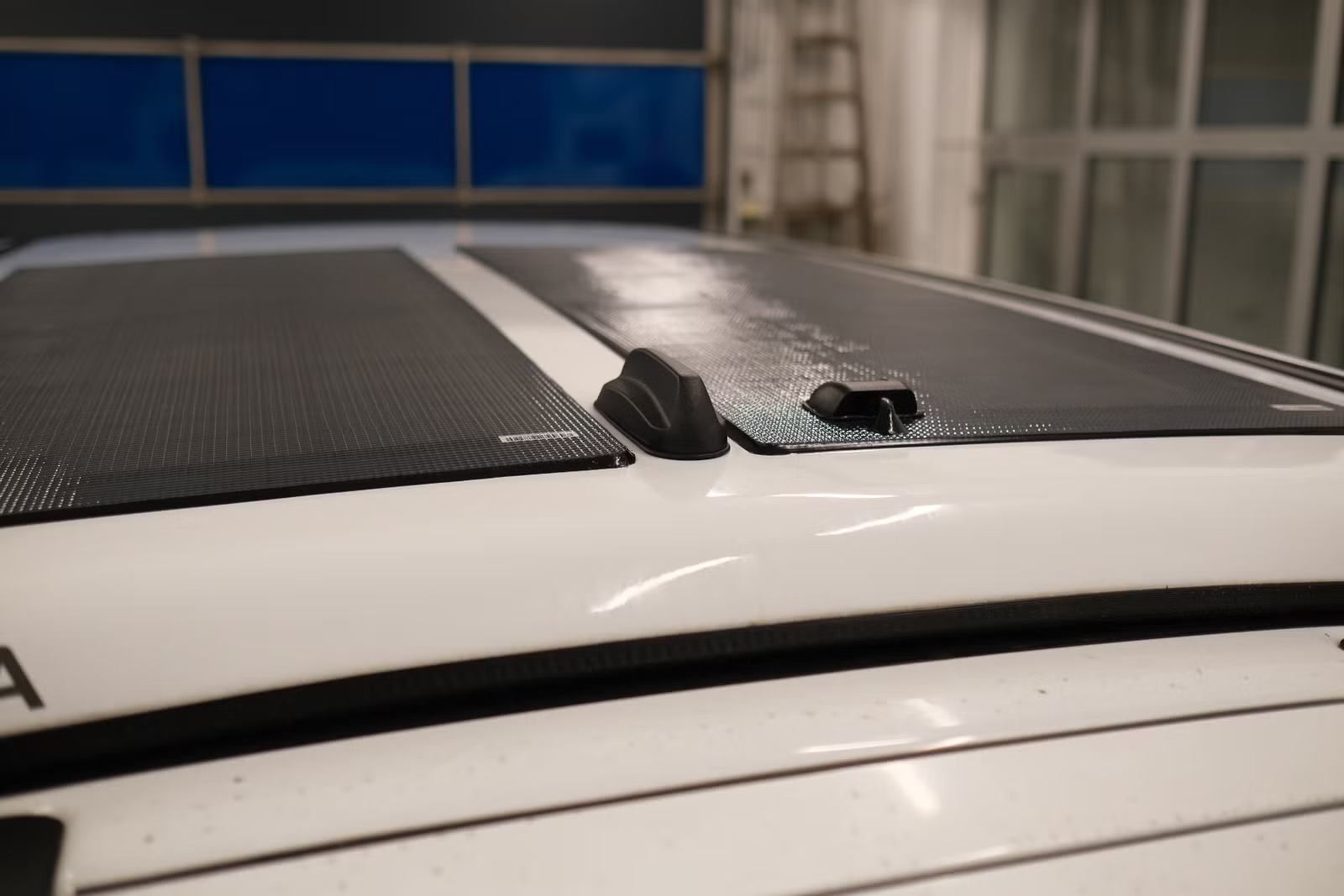
The roof antenna is positioned towards the rear, where the roof is lower. In this installation position it does not increase the vehicle's overall height. Roof racks can still be fitted and car washes can still be used. Always take account of the vehicle's actual dimensions, additional roof equipment and the rules of the facility concerned.
Allow for workshop installation and check what is included
The package includes the router, roof antenna and installation by the 1sternehotel workshop. This system is offered exclusively with workshop installation. Allow one working day with your vehicle for the installation.
The solar panels shown in the product photographs are not included and do not affect operation of the router system. The solar system for the Mercedes-Benz Marco Polo is a separate product. Wireless charging in the pop-top roof is also a separate addition, for example to charge a smartphone while appropriately configured backups are running.
Technical specifications
Router
| MOBILE | |
| Mobile module | 4G (LTE) – Cat 4 up to 150 Mbps, 3G – Up to 42 Mbps, 2G – Up to 236.8 kbps |
| SIM switch | 2 SIM cards, auto-switch cases: weak signal, data limit, SMS limit, roaming, no network, network denied, data connection fail, SIM idle protection |
| Status | Signal strength, SINR, RSRP, RSRQ, Bytes sent/received |
| Bridge | Direct connection (bridge) between mobile ISP and device on LAN |
| SMS | SMS status, SMS configuration, send/read SMS via HTTP POST/GET, EMAIL to SMS, SMS to EMAIL, SMS to HTTP, SMS to SMS, scheduled SMS, SMS autoreply, SMPP |
| Black/White list | Operator black/white list |
| Multiple PDN (optional) | Possibility to use different PDNs for multiple network access and services |
| Band management | Band lock, Used band status display |
| WIRELESS | |
| Wireless mode | IEEE 802.11b/g/n, Access Point (AP), Station (STA) |
| WiFi | WPA2-Enterprise (with external/internal Radius server), WPA2-PSK, WPA-PSK, WEP, MAC Filter |
| WiFi security | WPA2-Enterprise - PEAP, TLS, TTLS. AES-CCMP, TKIP, Auto Cipher modes. Client separation |
| SSID | SSID stealth mode and access control based on MAC address |
| WiFi users | up to 100 simultaneous connections |
| Wireless Hotspot | Captive portal (Hotspot), internal/external Radius server, built in customizable landing page |
| ETHERNET | |
| WAN | 1 x WAN port (can be configured to LAN) 10/100 Mbps, comply IEEE 802.3, IEEE 802.3u standards, supports auto MDI/MDIX |
| LAN | 3 x LAN ports, 10/100 Mbps, comply IEEE 802.3, IEEE 802.3u standards, supports auto MDI/MDIX |
| NETWORK | |
| Routing | Static routing, Dynamic routing (BGP, OSPF v2, RIP v1/v2) |
| Network protocols | TCP, UDP, IPv4, IPv6, ICMP, NTP, DNS, HTTP, HTTPS, FTP, SMTP, SSL v3, TLS, ARP, VRRP, PPP, PPPoE, UPNP, SSH, DHCP, Telnet, SMPP, MQTT, Wake On Lan (WOL) |
| VoIP passthrough support | H.323 and SIP-alg protocol NAT helpers, allowing proper routing of VoIP packets |
| Connection monitoring | Ping Reboot, Periodic Reboot, LCP and ICMP for link inspection |
| Firewall | Port forward, traffic rules, custom rules |
| DHCP | Static and dynamic IP allocation, DHCP Relay |
| QoS | Traffic priority queuing by source/destination, service, protocol or port, WMM, 802.11e |
| DDNS | Supported >25 service providers, others can be configured manually |
| Network backup | VRRP, Mobile, Wired and WiFi WAN options, each of which can be used as backup, using automatic Failover |
| Load balancing | Balance your internet traffic over multiple WAN connections |
| NetSnapper (optional) | Mobile connection management, data compression VPN client (not available in standard FW) |
| SSHFS (optional) | Possibility to mount remote file system via SSH protocol (not available in standard FW) |
| SECURITY | |
| Authentication | Pre-shared key, digital certificates, X.509 certificates |
| Firewall | Pre-configured firewall rules can be enabled via web-ui, unlimited firewall configuration via CLI; DMZ; NAT; NAT-T |
| Attack prevention | DDOS prevention (SYN flood protection, SSH attack prevention, HTTP/HTTPS attack prevention), port scan prevention ( SYN-FIN, SYN-RST, X-mas, NULL flags, FIN scan attacks) |
| WiFi security | WPA2-Enterprise - PEAP, TLS, TTLS. AES-CCMP, TKIP, Auto Cipher modes. Client separation |
| VLAN | Port based and tag based VLAN separation |
| Mobile quota control | Set up custom data limits for both SIM cards |
| WEB filter | Blacklist for blocking out unwanted websites, whitelist for specifying allowed sites only |
| Access control | Flexible access control of TCP, UDP, ICMP packets, MAC address filter |
| VPN | |
| OpenVPN | Multiple clients and server can be running simultaneously, 12 encryption methods |
| OpenVPN Encryption | DES-CBC, RC2-CBC, DES-EDE-CBC, DES-EDE3-CBC, DESX-CBC, BF-CBC, RC2-40-CBC, CAST5-CBC, RC2-64-CBC, AES-128-CBC, AES-192-CBC, AES-256-CBC |
| IPsec | IKEv1, IKEv2, supports up to 4 x VPN IPsec tunnels (instances), with 5 encryption methods (DES, 3DES, AES128, AES192, AES256) |
| GRE | GRE tunnel |
| PPTP, L2TP | Client/Server services can run simultaneously |
| Stunnel | Proxy designed to add TLS encryption functionality to existing clients and servers without any changes in the programs' code |
| SSTP | SSTP client instance support |
| MODBUS | |
| Modbus TCP slave | ID range 1-255 |
| Modbus TCP master | Supported functions 01, 02, 03, 04, 05, 06, 15, 16 Supported data formats 8 bit: INT, UINT; 16 bit: INT, UINT (MSB or LSB first); 32 bit float (Big endian, Big endian with byte-swapped, Little endian, Little endian with byte-swapped) |
| MODBUS RTU MASTER (RS232) | |
| Supported baud rates | From 300 to 115200 |
| Supported functions | 01, 02, 03, 04, 05 (only for alarms), 06 (only for alarms), 15 (only for alarms), 16 (only for alarms) |
| Number of data bits | From 5 to 8 |
| Number of stop bits | 1 or 2 |
| Parity | None, Even, Odd |
| Flow | None, RTS/CTS, Xon/Xoff |
| Duplex | Full duplex |
| MODBUS RTU MASTER (RS485) | |
| Supported baud rates | From 300 to 115200 |
| Supported functions | 01, 02, 03, 04, 05 (only for alarms), 06 (only for alarms), 15 (only for alarms), 16 (only for alarms) |
| Number of data bits | From 5 to 8 |
| Number of stop bits | 1 or 2 |
| Parity | None, Even, Odd |
| Flow | None, RTS/CTS, Xon/Xoff |
| Duplex | Full duplex |
| MONITORING & MANAGEMENT | |
| WEB UI | HTTP/HTTPS, status, configuration, FW update, CLI, troubleshoot, event log, system log, kernel log |
| FOTA | Firmware update from server, automatic notification |
| SSH | SSH (v1, v2) |
| SMS | SMS status, SMS configuration, send/read SMS via HTTP POST/GET |
| TR-069 | OpenACS, EasyCwmp, ACSLite, tGem, LibreACS, GenieACS, FreeACS, LibCWMP, Friendly tech, AVSystem |
| MQTT | MQTT Broker, MQTT publisher |
| SNMP | SNMP (v1, v2, v3), SNMP trap |
| JSON-RPC | Management API over HTTP/HTTPS |
| MODBUS | MODBUS TCP status/control |
| RMS | Teltonika Remote Management System (RMS) |
| SYSTEM CHARACTERISTICS | |
| CPU | Atheros Wasp, MIPS 74Kc, 550 MHz |
| RAM | 128 MB, DDR2 |
| FLASH memory | 16 MB SPI Flash |
| FIRMWARE / CONFIGURATION | |
| WEB UI | Update FW from file, check FW on server, configuration profiles, configuration backup, restore point |
| FOTA | Update FW/configuration from server |
| RMS | Update FW/configuration for multiple devices |
| Keep settings | Update FW without losing current configuration |
| FIRMWARE CUSTOMIZATION | |
| Operating system | RutOS (OpenWrt based Linux OS) |
| Supported languages | Busybox shell, Lua, C, C++ |
| Development tools | SDK package with build environment provided |
| LOCATION TRACKING | |
| GNSS | GPS, GLONASS, BeiDou, Galileo and QZSS |
| Coordinates | GNSS coordinates via WebUI, SMS, TAVL, RMS |
| NMEA | NMEA 0183 |
| NTRIP | NTRIP protocol (Networked Transport of RTCM via Internet Protocol) |
| Server software | supported server software TAVL, RMS |
| Mobile Network Geolocation | Location without using GPS, get approximate location based on mobile tower on RMS |
| Geofencing | Configurable multiple geofence zones |
| SERIAL | |
| RS232 | DB9 connector, full RS232 (with RTS, CTS) |
| RS485 | RS485 Full Duplex (4 wires) and Half Duplex (2 wires). 300-115200 baud rate |
| Serial functions | Console, Serial over IP, Modem, Modbus gateway, NTRIP Client |
| INPUT/OUTPUT | |
| Input | 1 x digital input (0 - 3 V), 1 x digital galvanically isolated input (0 - 30 V), 1 x analog input (0 - 24 V), 1 x Digital non-isolated input (on 4 pin power connector) |
| Output | 1 x digital open collector output (30 V, 250 mA), 1 x SPST relay output (40 V, 4 A), 1 x Digital open collector output (30 V, 300 mA, on 4 pin power connector) |
| Events | SMS, EMAIL, RMS |
| USB | |
| Data rate | USB 2.0 |
| Applications | Samba share, custom scripts |
| External devices | Possibility to connect external HDD, flash drive, additional modem, printer |
| Storage formats | FAT, FAT32, NTFS |
| SD CARD | |
| Physical size | Micro SD |
| Applications | Samba share, custom scripts |
| Capacity | Up to 32 GB |
| POWER | |
| Connector | 4 pin industrial DC power socket |
| Input voltage range | 9 – 30 VDC (4 pin industrial socket), reverse polarity protection; surge protection >31 VDC 10us max |
| PoE (passive) | Passive PoE over spare pairs. Possibility to power up through LAN port, not compatible with IEEE802.3af and 802.3at standards |
| Power consumption | < 2 W idle, < 7 W Max |
| PHYSICAL INTERFACES (PORTS, LEDS, ANTENNAS, BUTTONS, SIM) | |
| Ethernet | 4 x RJ45 ports, 10/100 Mbps |
| I/O’s | 10 Inputs/Outputs pin connector, 2 Inputs/Outputs pin on 4 pin power connector (available from HW revision 1600) |
| Status LEDs | 1 x bi-color connection status LED, 5 x connection strength LEDs, 4 x LAN status LEDs, 1 x Power LED |
| SIM | 2 x SIM slots (Mini SIM - 2FF), 1.8 V/3 V, external SIM holders |
| Power | 4 pin power connector with 2 pins for Input/Output |
| Input/output | 10 pin industrial socket for inputs/outputs |
| Antennas | 2 x SMA for LTE, 1 x SMA for GNNS, 2 x RP-SMA for WiFi antenna connectors |
| USB | USB A port for external devices |
| SD card | Micro SD card slot |
| RS232 | DB9 socket for full-featured RS232 |
| RS485 | 6 pin industrial socket for 2/4 wire RS485 |
| Reset | Reset/restore to default button |
| PHYSICAL SPECIFICATION | |
| Casing material | Aluminium housing, plastic panels |
| Dimensions | 50 mm x 100 mm x 110 mm (H x W x D) |
| Weight | 287 g |
| Mounting options | DIN rail (can be mounted on two sides), flat surface placement |
| OPERATING ENVIRONMENT | |
| Operating temperature | -40 °C to 75 °C |
| Operating humidity | 10% to 90% non-condensing |
| Ingress Protection Rating | IP30 |
| MTBF | 230000 h |
| REGULATORY & TYPE APPROVALS | |
| Regulatory | CE/RED, FCC, IC/ISED, EAC, RCM, PTCRB, RoHS, WEEE, Wi-Fi Alliance |
| Operator | AT&T, Verizon |
| Vehicle | ECE R10 (E-mark) ECE R118 |
| EMI IMMUNITY | |
| Standards | Draft EN 301 489-1 V2.2.0, Draft EN 301 489-17 V3.2.0, Draft EN 301 489-19 V2.1.0, Draft EN 301 489-52 V1.1.0 FCC 47 CFR Part 15B (2017), ANSI C63.4 (2014) |
| ESD | EN61000-4-2:2009 |
| RS | EN 61000-4-3:2006 + A1:2008 + A2:2010 |
| EFT | EN 61000-4-4:2012 |
| Surge immunity (AC Power Line) | EN 61000-4-5:2006 |
| Surge immunity (Ethernet ports) | EN 61000-4-5:2014, clause 7.1 of ITU-T K21 |
| Transient and surges | ISO 7632-2:2004 |
| CS | EN 61000-4-6:2009 |
| DIP | EN 61000-4-11:2004 |
| RF | |
| Standards | EN 300 328 V2.1.1, EN 301 511 V12.5.1, EN 301 908-1 V11.1.1, EN 301 908-2 V11.1.1, EN 301 908-13 V11.1.1, EN 303 413 V1.1.0 AS/CA S042.1:2018, AS/ACIF S042.3:2005, AS/CA S042.4:2018, AS/NZS 4268:2017 FCC 47 CFR Part 15C (2017), FCC 47 CFR Part 2 (2017), FCC 47 CFR Part 22H (2017), FCC 47 CFR Part 24E (2017), FCC 47 CFR Part 27C (2017) RSS-Gen Issue 4 (2014), RSS-247 Issue 2 (2017), RSS-132 Issue 3 (2013), RSS-133 Issue 6 (2013), RSS-139 Issue 3, RSS-130 Issue 1 |
| SAFETY | |
| Standards | IEC 60950-1:2005 (Second Edition) + Am 1:2009 + Am 2:2013 AS/NZS 60950.1:2015 EN 50665:2017, EN 62311:2008 FCC 47 CFR Part 1 1.1310 RSS-102 Issue 5 (2015) |
| ENVIRONMENTAL | |
| Ingress Protect | LST EN 60529:1999+A1+AC:2002 |
| Vibration | Class guideline-DNVGL-CG-0339:2016 EN 60068-2-6:2008 |
Antenna: MIMO 5G/4G/3G/2G/WLAN+GPS/GNSS
| Electrical Data | |
| LTE Frequencies | 698-960/1710-3800MHz |
| Global Positioning | GPS / GNSS 1562-1612 |
| Wifi Frequencies | MiMo - 2.4/5.0GHz - (Optional) |
| LTE MiMo | 2x2 |
| WiFi MiMo | Optional 2x2 |
| Max Input Power (W) | 50 |
| Pattern | Omni-directional |
| Global Positioning Data | |
| Frequency Range (MHz) | 1562-1612 |
| LNA Gain (dB) | 26 |
| Mechanical Data | |
| Available Colours | Black |
| Length (mm) | 172 |
| Width (mm) | 61 |
| Height (mm) | 50 |
| Mounting Data | |
| Mounting Type | Panel Mount |
| Mounting Method | 18mm (3/4") Mounting Bush |
| Whip Mounting | M6x0.75 |
| Approvals Data | |
| IP Rating | IP66 |
| Flame Retardancy | UN118.01 Compliant |
Which vehicles and pop-top roofs is the system intended for?
The product details list Mercedes-Benz Marco Polo, Activity and Horizon vehicles with an electric or manual pop-top roof, with or without a sunroof. Compatibility with the Viano Marco Polo W639 is not specified in these details.
What is included and how long does installation take?
The package includes the Teltonika MiMo router, Panorama Shark MiMo roof antenna and installation by the 1sternehotel workshop. The system is offered exclusively with installation. Your vehicle is required for one working day. The solar panels shown and the separately described wireless charging system are not included in this package.
Which SIM cards are needed and what is dual SIM used for?
The router has two slots for Mini-SIM cards in 2FF format. Internet access requires an activated SIM card with a suitable data plan. A second card enables automatic switching according to the configuration, for example when the signal is weak, no network is available or a data limit is reached. It can also be used for an additional travel data plan.
How does the roof antenna help with weak reception, and does the router support 5G?
The external antenna and MiMo technology can improve mobile reception compared with using a smartphone on its own. However, there is no mobile internet connection without usable mobile network coverage. The router supports 4G/LTE Cat 4 with a theoretical maximum of 150 Mbps, plus the listed 3G and 2G technologies. The antenna's 5G designation does not make the router a 5G device.
How far does the WiFi reach and how many devices can connect?
WiFi is usable inside and around the vehicle. In open surroundings, several hundred metres may be possible depending on the location, obstacles and connected devices; this does not establish a fixed coverage radius. The specifications list up to 100 simultaneous connections. All connected devices share the available bandwidth.
How is the router powered and which operating modes are available?
Power comes from the leisure battery. A switch beside the rear 12 V socket allows continuous operation, ignition-controlled operation and complete shutdown. Power consumption is specified as below 2 W when idle and below 7 W maximum. Runtime depends on battery charge, capacity and other electrical loads.
Where are the router and antenna installed, and is the roof drilled?
The router is concealed behind the trim at the rear right, beside the tailgate. The antenna sits towards the rear of the pop-top, where the roof is lower. A hole is required for cable routing. The flexibly routed cables remain visible around the roof bed. The described installation does not increase overall vehicle height. Roof racks and car wash use remain possible; take account of additional roof equipment and each facility's rules.
How can settings be changed and devices connected by Ethernet?
A smartphone app for Apple and Android provides access to status information and settings. Removing the trim panel containing the rear 12 V socket gives access to the router for SIM changes or configuration over LAN. Up to four Ethernet cables can be connected on request using three LAN ports and the WAN port configured as LAN, each at 10/100 Mbps. WiFi can be switched off.
What is required for VPN connections, backups and calls?
VPN connections require appropriate router settings and a suitably configured endpoint, for example on a company network. Cloud backups and synchronisation depend on device and service settings and use your data allowance. WiFi calling and SIP calls require suitable devices, supported services and a sufficient internet connection.
| Brand | 1sternehotel |
| Item No. | 35994 |
| Content | 1 Installation |
| Condition | New |
| Weight | 3081 g |
| Customs tariff number | 85176200 |
| Manufacturer | Axel Seidel Peter-Seifert Str. 10 36129 Gersfeld Germany hello@1sternehotel.de |